
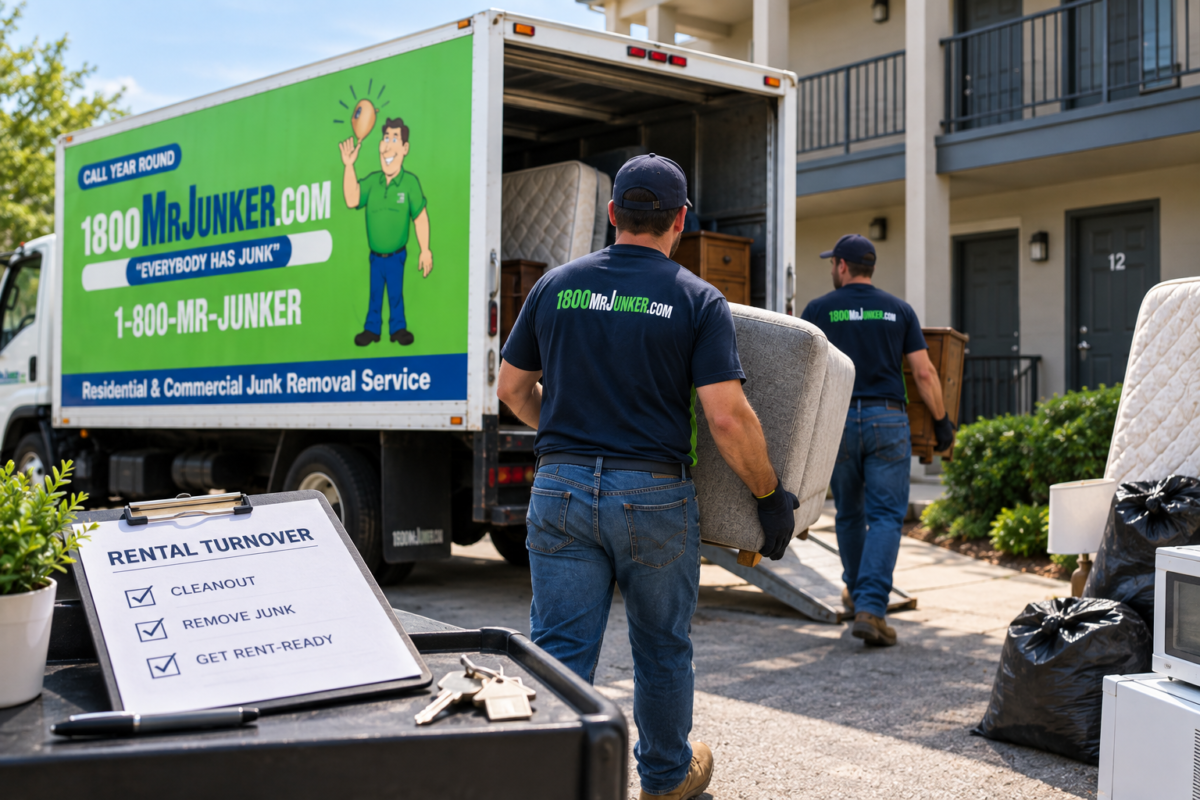
A tenant moves out — or is moved out — and there’s a couch, a mattress, three trash bags of clothes, and a broken microwave still sitting in the unit. Every day it stays there is a day the unit isn’t earning rent, and Connecticut has specific rules about what a landlord can and can’t do with property a tenant leaves behind.
This guide covers what Connecticut law actually requires for a tenant’s abandoned property, the difference between a routine move-out and a post-eviction cleanout, and how professional junk removal fits into getting a unit rent-ready fast.
Connecticut treats a voluntary move-out differently from a formal eviction. If a tenant simply vacates and doesn’t intend to return, the landlord must send notice, then inventory and hold the property for at least 30 days before disposing of it (Conn. Gen. Stat. § 47a-11b). If a tenant is formally evicted through summary process, a state marshal removes the property to municipal storage, and the tenant has 15 days to reclaim it before the town may sell it at auction (Conn. Gen. Stat. § 47a-42). Once you’re legally clear to dispose of what’s left, 1-800-Mr-Junker can clear the unit same-day or next-day so it’s ready to show and re-rent.
Why Rental Turnovers Are Different From a Typical Cleanout
A homeowner clearing out a garage can take as long as they want. A landlord can’t. Every day a unit sits full of a former tenant’s belongings is a day it isn’t generating rent, and in a market where security deposit deadlines and lease start dates are already ticking, cleanout speed has a real dollar value attached to it.
Turnovers also come with a legal wrinkle homeowner cleanouts don’t: the items in the unit may not legally be yours to throw away yet. Connecticut law gives departed tenants a window to reclaim their property, and skipping that step — even with good intentions — can expose a landlord to a claim.
Connecticut Law: Voluntary Move-Out vs. Eviction
Connecticut handles a tenant’s leftover property differently depending on how the tenancy actually ended. Getting this distinction right matters before anything gets thrown away.
If the Tenant Simply Vacated (Abandonment)
Under Conn. Gen. Stat. § 47a-11b, “abandonment” means the tenant vacated without notice and doesn’t intend to return — typically shown by removing most of their belongings plus either two months of unpaid rent or a clear statement they’re not coming back.
If that’s the situation, the law requires:
- Sending notice to the tenant’s last-known address by both regular mail and certified mail, return receipt requested
- Giving the tenant 10 days from receipt to contact you before you re-enter and take possession
- Inventorying whatever possessions remain and holding them for at least 30 days
- Only after that 30-day window may the landlord dispose of the property “as he deems appropriate”
If the Tenant Was Formally Evicted
A formal eviction is a different legal process, governed by Conn. Gen. Stat. § 47a-42. Once a court enters a summary process judgment and any stay of execution expires, a state marshal — not the landlord directly — handles removal:
- The marshal gives the town’s chief executive officer notice of the eviction date, time, and a general description of the property
- The marshal uses reasonable efforts to notify the tenant of the eviction date and the possibility of a sale
- Possessions are delivered to a storage location designated by the town
- The tenant has 15 days after the eviction to reclaim the property and pay storage costs
- If unclaimed after 15 days, the town may sell the property at public auction after one week of posted notice
- The tenant has 30 days after the sale to claim any net proceeds; unclaimed proceeds go to the town treasury
The key takeaway: after a formal eviction, disposal isn’t solely the landlord’s call — it runs through the marshal and the municipality, on a different timeline than a simple move-out.
A Pending Change Worth Watching
A 2026 bill (SB 337) originally proposed shifting eviction-related storage and disposal responsibility more directly onto landlords. As introduced, it would have required the landlord to hold property for 15 days and then allowed disposal “as such plaintiff sees fit.” However, the bill that actually advanced out of the Housing Committee was revised into a measure to study the issue — an “Act Establishing a Task Force Concerning the Removal and Storage of Property of Evicted Tenants” — rather than a change to the law itself, and it did not reach a floor vote this session.
As of this writing, current law under § 47a-42 is unchanged. It’s worth keeping an eye on future sessions, since this is clearly a topic the legislature is revisiting, but landlords should follow the existing marshal/municipal-storage process, not the process proposed in the original bill.
The Security Deposit Clock Is Running Too
While you’re clearing out a unit, a separate deadline is already ticking. Under Conn. Gen. Stat. § 47a-21, a landlord must return a tenant’s security deposit — with any accrued interest, or an itemized statement of deductions — within 21 days after the tenancy ends, or 15 days after the tenant provides a forwarding address, whichever is later. Missing that deadline can make a landlord liable for double the deposit amount.
A fast, documented cleanout doesn’t just get the unit re-rented sooner — it gives you clear photos and a clean record to support any deductions before that clock runs out.
Common Mistakes Landlords Make During Turnovers
Disposing of Property Too Soon
The single most common mistake: throwing out a former tenant’s belongings before the required notice and holding periods have run, especially in an abandonment situation where there was no court involvement at all.
Skipping the Inventory
Even when a landlord is confident items are abandoned, Connecticut law requires an inventory before disposal in the abandonment scenario. Skipping this step removes a landlord’s protection under the statute if a dispute comes up later.
Assuming Eviction and Abandonment Follow the Same Rules
These are two different legal tracks with different notice requirements, different holding periods, and — in the eviction case — a different party (the municipality) handling the property. Treating a formal eviction like a simple move-out is a common and avoidable error.
Waiting to Book Cleanup Help Until the Legal Window Closes
Lining up a junk removal crew in advance, so they’re ready to go the moment you’re legally clear to dispose of what’s left, keeps a unit from sitting vacant any longer than it has to.
Once you’re clear to dispose of what’s left behind, we can usually be there the same day.
What We Remove During a Rental Turnover
- Furniture, mattresses, and box springs
- Refrigerators, stoves, washers, and dryers
- Televisions, computers, and other electronics
- Trash, debris, and general household clutter left behind
- Damaged flooring, cabinetry, or renovation debris between tenants
- Yard waste and exterior cleanup
Appliances and mattresses come with their own Connecticut disposal rules — refrigerant recovery and mattress recycling requirements are covered in detail on our Mattress & Appliance Disposal in CT guide, and we handle both correctly through our own recycling facility.
Why Landlords and Property Managers Call 1-800-Mr-Junker
- Same-day and next-day scheduling — book once you’re legally clear to dispose, and we’re often there the same day
- Two truck sizes — a 15-yard standard truck for a single-unit turnover, or a 30-yard truck for a full building cleanout
- Volume-based, upfront pricing — know your cost before the crew starts loading, whether it’s one unit or several
- Full-service crews — we load everything, including appliances and furniture from upper floors or tight stairwells
- Recycling and donation built in — we recycle or donate roughly 90% of what we haul through our own facility, so cleared-out items don’t just go to a landfill
- Statewide coverage — from single-family rentals to multi-family buildings across New Haven, Fairfield, Hartford, and Litchfield counties
If your turnover also involves a larger renovation between tenants, it’s worth reading our comparison of dumpster rental vs. junk removal to figure out which approach fits the scope of work.
Frequently Asked Questions
Can I just throw away a tenant’s belongings after they move out?
Not immediately. If the tenant abandoned the unit, Connecticut law requires notice and a minimum 30-day holding period before disposal. If the tenant was formally evicted, the property goes through a state marshal and municipal storage process with a 15-day reclaim window instead.
What’s the difference between abandonment and eviction for property disposal purposes?
Abandonment (Conn. Gen. Stat. § 47a-11b) applies when a tenant leaves voluntarily without notice and doesn’t intend to return. Eviction (Conn. Gen. Stat. § 47a-42) applies when a court has entered a summary process judgment and a marshal executes it. Each has its own notice requirements and timeline.
How long do I have to hold onto a tenant’s abandoned property?
At least 30 days after sending the required notice, under Conn. Gen. Stat. § 47a-11b. Only after that period may the landlord dispose of the property as they see fit.
Is 1-800-Mr-Junker able to remove items immediately after an eviction?
We can schedule a cleanout as soon as you’re legally authorized to dispose of the remaining property. We’re not part of the marshal or municipal storage process itself, but once that process has run its course, we can typically be on-site same-day or next-day.
Do you work with property managers handling multiple units?
Yes. We regularly work with landlords and property managers on single-unit turnovers as well as larger multi-unit and full-building cleanouts, with upfront pricing based on volume.
What happens to the items you remove?
We recycle or donate roughly 90% of what we haul through our own recycling facility, rather than sending it straight to a landfill. Learn more on our Charity & Recycle page.
This article provides general information about Connecticut law and is not a substitute for legal advice. Landlords with a specific abandonment or eviction situation should consult an attorney or their local state marshal’s office before disposing of a tenant’s property.
Ready to Turn Over Your Unit Fast?
Once you’re clear to dispose of what’s left behind, call 1-800-Mr-Junker or book online for same-day or next-day service anywhere in Connecticut.